Aug 10, 2026
What to Ask For: A Plain-English Guide to Fades
Most bad haircuts aren't a skill problem. They're a translation problem.
You walk in with a picture in your head. You say a word you heard somewhere. Your barber hears that word and pictures something else. Forty minutes later you're both looking in the mirror being polite about it.
Here's the vocabulary, in plain English, so that stops happening.
First: taper vs. fade
These get used interchangeably and they aren't the same thing.
A taper is just the gradual shortening around your edges — the sideburns and the back of the neck. The bulk of your sides stays the length it is. It's subtle. Most people wouldn't notice you got a haircut, they'd just notice you look put together.
A fade takes the whole side of your head from short at the bottom to longer at the top, blended so there's no visible jump between lengths. It's a bigger change and a stronger look.
If you want something conservative that works in any office, ask for a taper. If you want the sides visibly short, ask for a fade.
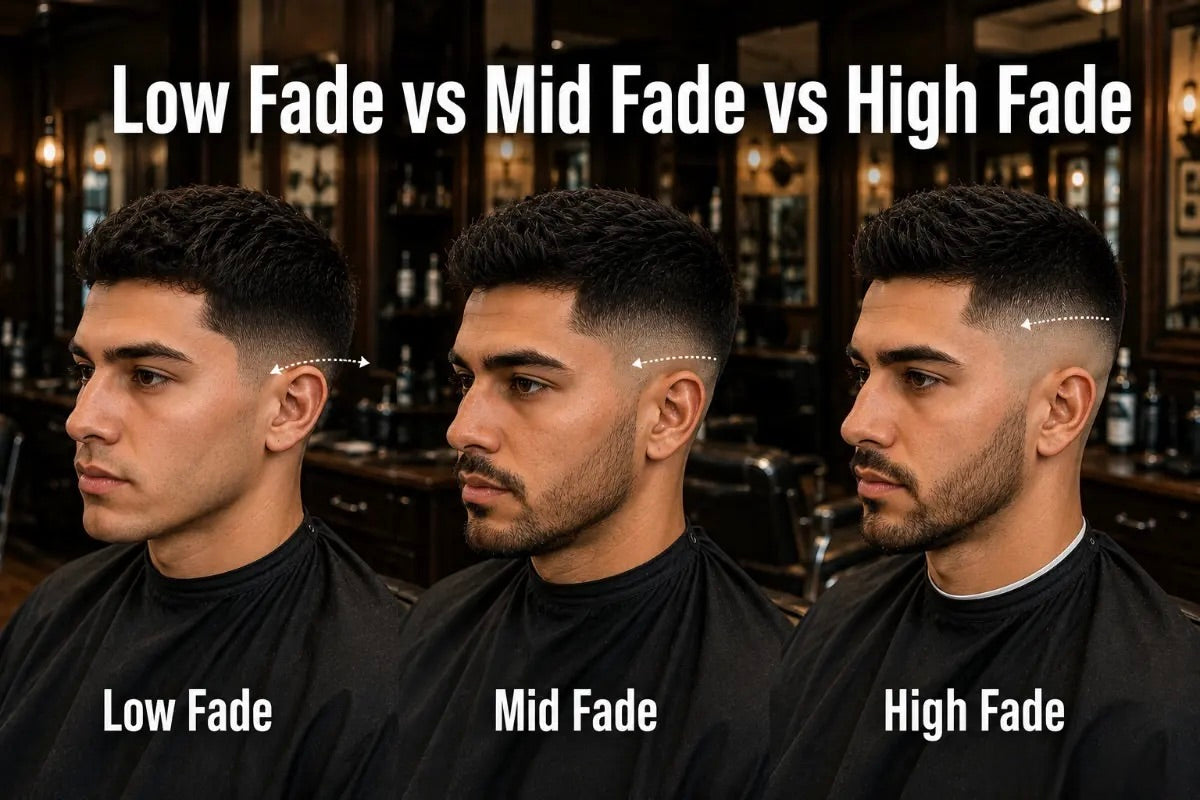
Where the fade starts: low, mid, high
This is the single most useful thing to understand, because it's the difference between three haircuts that people call by the same name.
The words low, mid, and high describe where the shortest part stops and the blend starts climbing — not how short it gets.
- Low fade. Starts just above the ear and stays down near the hairline. Softest of the three. Keeps most of your side hair intact. Best if you want short sides without a dramatic look.
- Mid fade. Starts around the temple, roughly halfway up the side of your head. The default. Balanced, works on most people, hardest to get wrong.
- High fade. Starts up near the corner of your forehead, close to where the top section begins. Sharpest contrast. Great if you want the shape on top to stand out. Less forgiving — grows out faster and demands you come back sooner.
Same haircut, three completely different results. If you only say one specific word to your barber, make it this one.
How short the shortest part goes
Separate question from the one above. Once you've picked where the fade starts, you decide how short it goes at the bottom.
- Skin fade (also called a bald fade) goes down to nothing — clean skin at the bottom edge, blended up. Highest contrast, sharpest look, and it reads as grown out fastest, usually around week two.
- A number one or number two at the bottom keeps a shadow of hair there. Slightly softer, and it holds its shape longer between visits.
A high skin fade and a low number-two fade are both "fades" and they look nothing alike.
The specialty shapes
Worth knowing so you can recognize them, though most people don't need them.
- Drop fade. The fade line curves down behind the ear instead of running straight across. Follows your head's natural curve. Pairs well with longer hair on top.
- Burst fade. Fades in a semicircle around the ear only, leaving the back of the head longer. Common with mohawks, mullets, and textured styles.
- Temp fade. Just the corners at the temples taken short and lined up. Not a full fade — an edge-up detail that can be added to almost anything.
What to actually say in the chair
Forget getting the terminology perfect. These four sentences will get you a better haircut than any single vocabulary word:
- "I want a low / mid / high fade, down to skin / a one / a two." Location and shortness. That's your fade, fully specified.
- "Leave about this much on top." Show it with your fingers. Inches mean nothing to anybody. Fingers don't lie.
- "I style it with nothing / a little cream / paste, pushed back." This tells your barber how to cut it, not just how to finish it.
- "I'll be back in about four / six weeks." A cut built for a six-week gap is a different cut than one built for three.
Bring a photo if you have one. Not to copy — to communicate. Just say what you like about it, and be honest if your hair isn't the same as the guy's in the picture. A good barber will tell you what will and won't transfer.
The thing nobody tells you
Your first haircut at a new shop is a conversation. Your third is where it gets good.
Tell your barber what you did and didn't like last time. "A little shorter on top" or "the fade felt too high for me" isn't criticism — it's the most useful thing you can hand them. That's how the cut gets dialed in and stays dialed in.
If you're in Nashville and you'd rather not guess your way through this, book a first appointment. New clients get extra time in the chair specifically so we can figure out what you actually want before anybody picks up a clipper.